The Gut–Weight Connection
How Microbes Differ in Obesity
Why do some people gain weight more easily than others, even when they eat the same foods? One possible answer lies in the gut. Your intestines are home to trillions of microbes, and their balance looks different in people with obesity compared to those who are lean. These shifts don't just affect body weight — they're also linked to cholesterol, blood sugar, and inflammation [1], [2]
The Gut Bacteria "Fingerprint"
Research shows that some microbes are more common in lean people, while others tend to show up more often in obesity [2], [3]
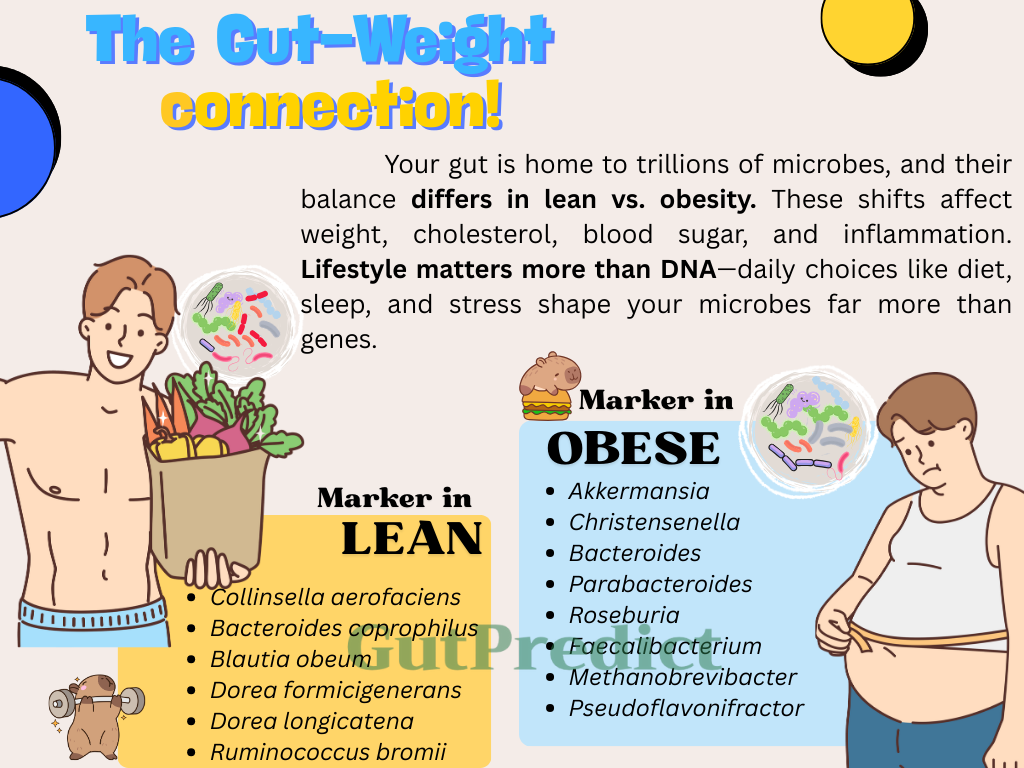
✓ More common in lean or normal weight
- Akkermansia – helps protect the gut lining and control blood sugar [2], [3]
- Christensenella – a heritable microbe strongly linked to lower body weight [2], [5]
- Bacteroides & Parabacteroides – thrive on fiber; linked with better metabolism [2], [3]
- Roseburia & Faecalibacterium – produce butyrate, a compound that reduces inflammation [2], [3]
- Methanobrevibacter – improves gut efficiency; often found in lean people [2]
- Pseudoflavonifractor – supports fiber digestion; reduced in obesity [3]
⚠ More common in obesity
- Collinsella aerofaciens – linked with higher triglycerides and inflammation [3]
- Bacteroides coprophilus – associated with higher BMI [3]
- Blautia obeum – tied to altered metabolism [3]
- Dorea (formicigenerans & longicatena) – often elevated; linked with more energy harvest [3]
- Ruminococcus bromii – breaks down resistant starch; sometimes linked with weight gain [3]
Lessons from Twins and Transplants
Genes or Lifestyle?
Genes play a role, but a smaller one than once thought. For example, Christensenella tends to run in families [2], [5], and links exist between certain genes (like lactase) and specific bacteria [5]. But overall, diet, lifestyle, sleep, and stress have far greater influence. As Hall, Tolonen & Xavier (2017) note, most microbiome differences between lean and obese people are due to modifiable lifestyle factors, not DNA [5].
Gut Bacteria and Blood Markers
Your gut profile shows up in blood tests too [2], [4]:
- ✓ Healthy gut diversity (seen more in lean people) → higher HDL (“good” cholesterol), lower triglycerides, better blood sugar, and less inflammation.
- ⚠Obesity-type profiles → higher LDL ("bad" cholesterol), higher triglycerides, insulin resistance, and raised CRP (inflammation marker).
The Takeaway
Your gut microbes aren’t fixed — they’re partners you can guide. Eating fiber-rich fruits, vegetables, whole grains, and fermented foods helps “good” bacteria thrive. That not only supports weight control but also improves cholesterol, blood sugar, and inflammation.
“Every meal is a chance to feed the microbes that work for your health.”
References
- Turnbaugh PJ, Ley RE, Mahowald MA, et al. (2006). An obesity-associated gut microbiome with increased capacity for energy harvest. Nature, 444:1027–1031.
- Goodrich JK, Waters JL, Poole AC, et al. (2014). Human genetics shape the gut microbiome: Christensenella associated with leanness. Cell, 159(4):789–799.
- Li Y, et al. (2025). Gut microbiota and obesity: metabolic and inflammatory mechanisms. Int J Mol Sci, 26(13):6282.
- Wastyk HC, et al. (2021). Gut-microbiota-targeted diets modulate human immune status. Cell, 184:1896–1911.
- Hall AB, Tolonen AC, Xavier RJ. (2017). Human genetic variation and the gut microbiome in disease. Nat Rev Genet, 18:690–699.